Skip to content
MountNemo Door SpecialistsOpen 24/7 (289) 203-0726
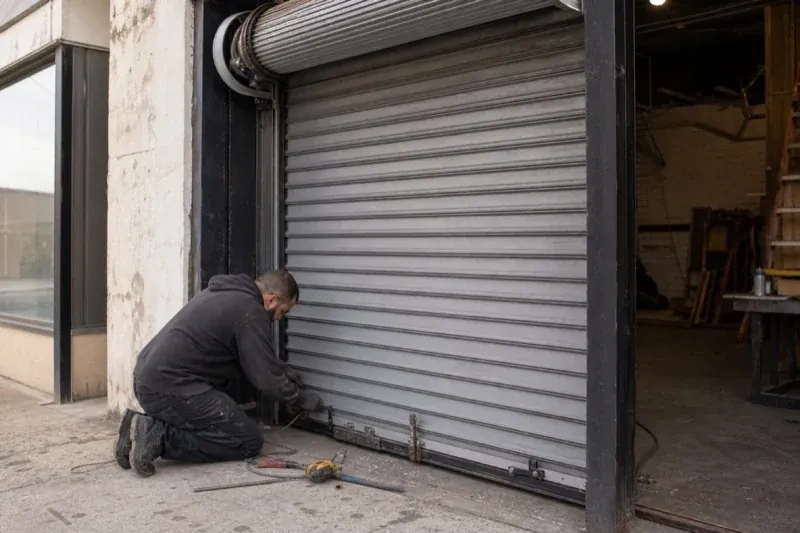
Person kneeling beside the bottom of a metal rolling door with tools on the ground — Commercial Rolling Door Repair, Hamilton

New Doors · Hamilton

Commercial Rolling Door Repair

The labelled rolling fire door still moves from its control, yet the release assembly and closing path were disturbed during nearby work. The facility needs the repair and return-to-service record handled as a fire-door scope.
In plain words

Commercial rolling door repair treats the opening as one connected machine rather than a loose collection of parts. A coiling curtain travels inside guides, wraps around a barrel and is assisted by a spring counterbalance; a hand chain or powered operator supplies movement. The technician identifies that system, controls the work area, secures the curtain and checks how each part affects the others. Bent slats, shifted guides, worn drive parts, balance problems or control faults are corrected within an agreed scope. Controlled cycles then confirm straight travel, proper limits, usable controls and a clear closing path.

Sound familiar?Hamilton

The call
The labelled rolling fire door still moves from its control, yet the release assembly and closing path were disturbed during nearby work. The facility needs the repair and return-to-service record handled as a fire-door scope.

NextHow the visit goes

Commercial Rolling Door Repair · Hamilton

How the visit goes

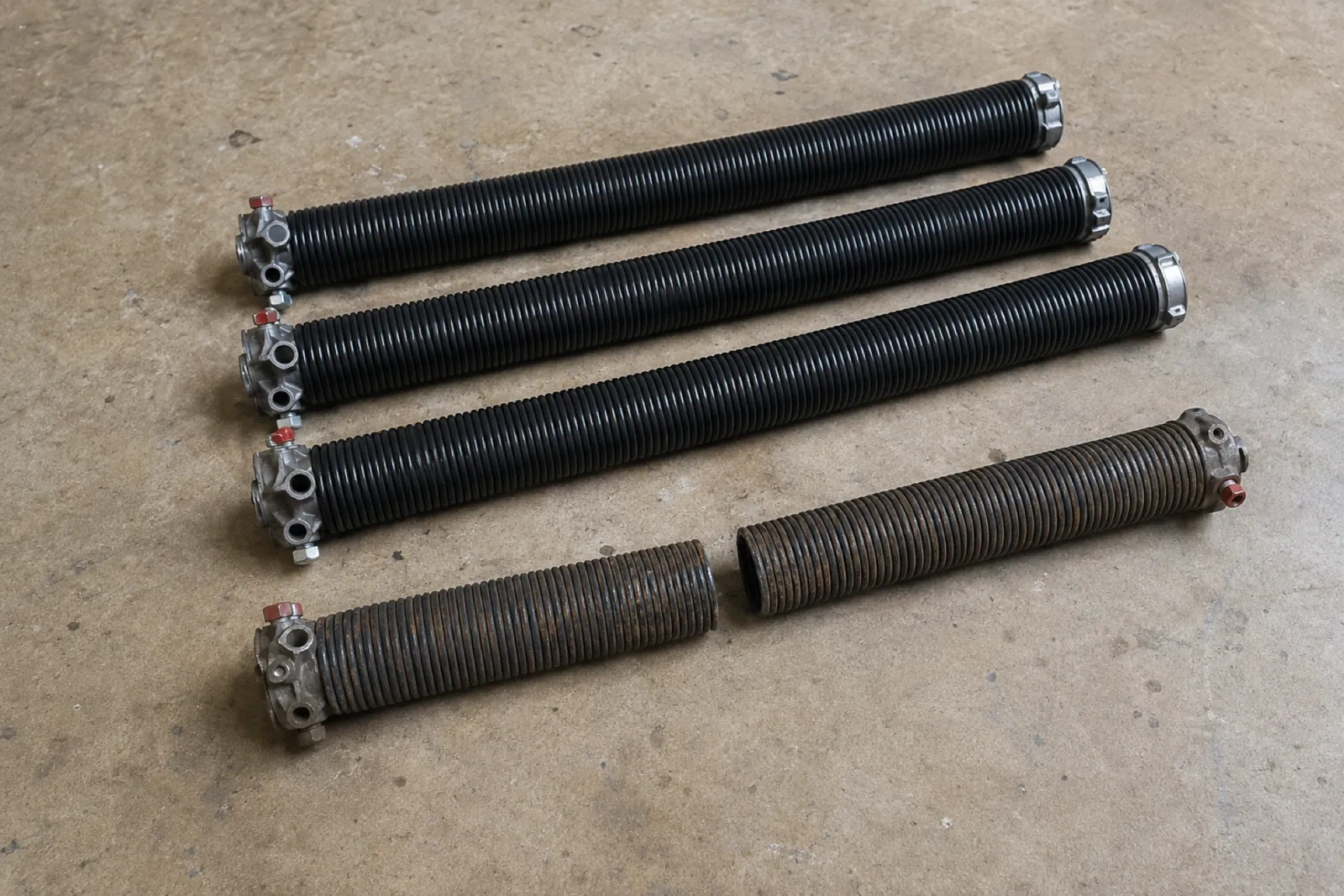
Four long coiled garage-door springs on a concrete floor, three black with metal end cones and one rusty spring broken in two. — Hamilton
  1. Scene 1

    Start with the operating story

    The first clues come from the people who use the opening. The technician asks whether the change appeared after an impact, power interruption, cold night or gradual increase in noise; where the curtain stops; which control was used; and how many cycles the door normally sees. Staff can also point out a lock that sticks, a manual chain that has become heavy or a sensor that needs repeated cleaning. That history narrows the inspection before any cycling begins and distinguishes a one-time obstruction from wear that has been developing across the whole assembly.

  2. Scene 2

    Restore the bottom bar and closure line

    The bottom of the door determines how it meets the floor, carries locks and engages a sensing edge when fitted. A twisted bar is straightened or renewed within the agreed scope, damaged retainers and astragal are replaced, and slide bolts or cylinder-lock parts are aligned only after the curtain hangs square. For a powered assembly, lock interlocks are checked so an engaged lock and an operator command cannot work against each other. The close limit is then set to bring the seal into suitable contact without crushing it, leaving the doorway even and ready for a clear locking test.

  3. Scene 3

    Controls with clear, separate functions

    The handover distinguishes the wall station, key control, access input, photoelectric protection, sensing edge and any vehicle-detection accessory. Each device is demonstrated according to its role, and staff see the applicable response during a controlled test. Sensor lenses remain visible and clean, cables stay protected, and stored materials are kept outside the beam path. Private access codes are retained by the facility rather than written in a service record. With the functions separated clearly, a blocked beam can be handled as a housekeeping clue while an unusual operator response can be reported with useful detail.

In the van

  • Curtain slats and endlocks
  • Photoelectric sensors
  • Hand-chain hoist components
  • Counterbalance spring assembly
  • Bearings and tension wheel

What shapes the quoteMount Nemo Door Specialists

Electrical and structural coordination
Supply faults, building wiring, damaged framing or uncertain anchors may involve another responsible trade or professional. The rolling-door quote separates that coordination from authorised door-system tasks.
Counterbalance condition
Spring adjustment, bearing service and replacement of worn barrel-related parts require different labour and controls. Door weight, spring arrangement and operating position shape the counterbalance plan.
Traffic-control requirements
Loading schedules, pedestrian routes, lift-truck lanes and access to both faces determine how the work zone is maintained. Facility support and alternate routing form part of the service plan.

FeesSame any hour

Have it ready

Before you call · 0 / 3

(289) 203-0726

Answers in plain language

Can guide damage be straightened instead of replaced?

Some local bends can be corrected when the guide retains its strength, fastening points and required profile. Creased, torn, heavily corroded or repeatedly struck sections may call for compatible replacement. The choice also depends on guide gap, endlock or windlock arrangement, mounting construction and whether the door is part of a labelled fire-protection assembly.

What information helps before the visit?

Useful details include the opening size, curtain material, manual or powered operation, model labels, current door position, recent impact or weather event and the exact point where travel changes. Photos of the full opening, bottom bar, controls and labels can clarify the system. Mention a fire-protection label at the outset so that scope is recognised.

What can facility staff check between service visits?

Staff can observe bottom-bar level, new dents or rub marks, guide debris, loose visible fasteners, torn seals, sensor cleanliness, unusual sounds and changes in operating effort. They can keep the sill and doorway clear and record impacts. Spring tension, bracket release and internal repairs remain controlled technician tasks because those areas involve curtain weight and stored energy.

Hamiltoninformation

HamiltonOntario

Town
Hamilton
In business
12 years
Hours
Open 24/7
Nights, weekends and holidays, same fees
Visits
On-site assessment preferred. Request a visit or call.

2021 census: what it means at the door

Every square is one home in a hundred.

  • 61 in 100 homes · older homes
  • About 61% of homes in Hamilton were built in 1980 or earlier, according to the 2021 Census.Extension springs are common on older doors, and they should carry a safety cable through the middle so a broken spring is held rather than flung. Adding those cables is a small job the technician checks for and offers on any older door he services.
  • Single-detached houses make up about 56% of homes in Hamilton (2021 Census).A blend of housing means a blend of garages: spacious attached garages with full headroom on the detached lots, and tight tandem garages with little side room in the attached units. Openers, tracks and springs are all sized at the door rather than assumed from the street.

Source: Statistics Canada, Census Profile

Open Hamilton in Google Maps

On-site assessment

Request a visit.

The labelled rolling fire door still moves from its control, yet the release assembly and closing path were disturbed during nearby work.

(289) 203-0726, open 24/7.