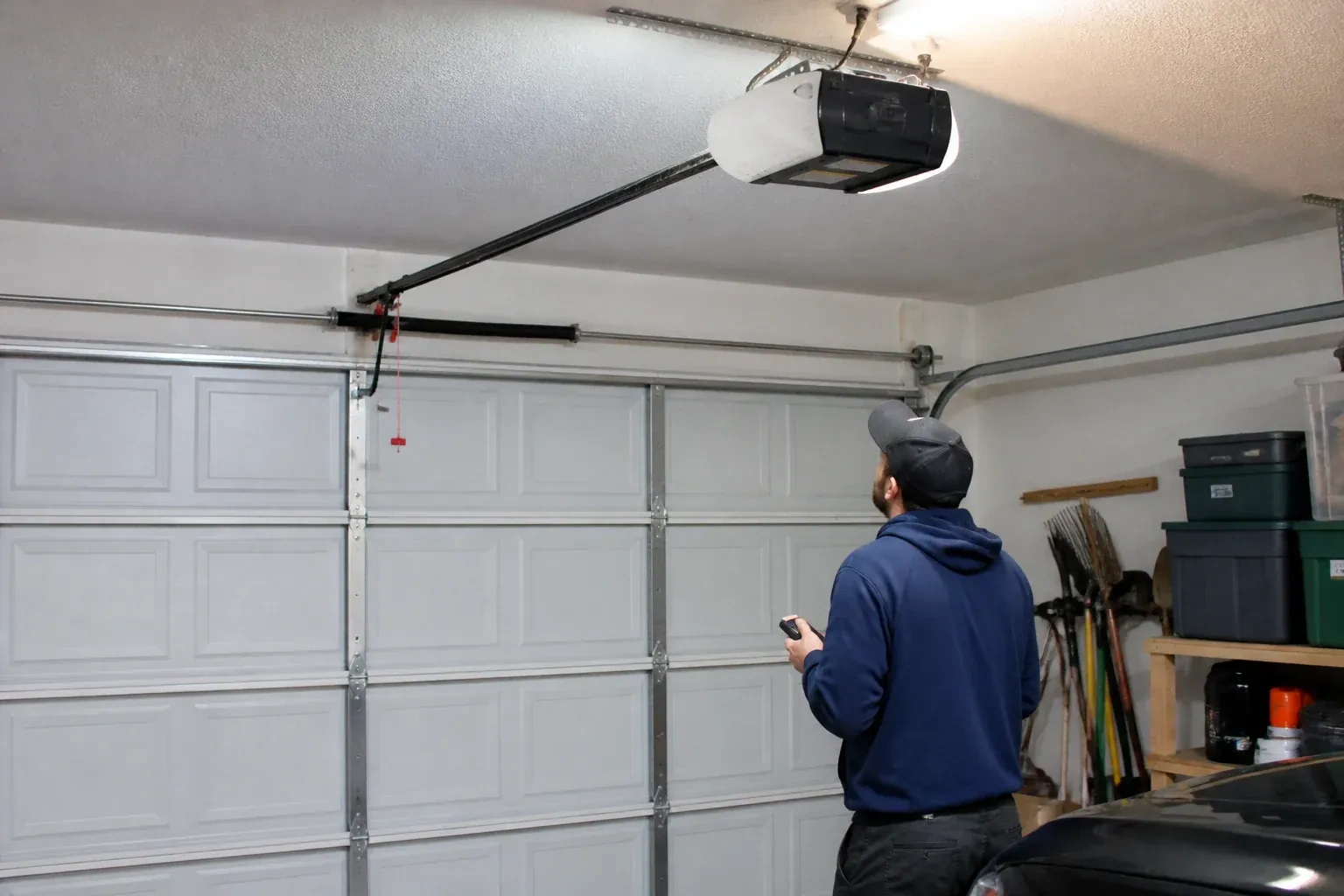
Sound familiar?West Hamilton
- The call
- There is a new squeal from the front of the rail, up near the header, on every cycle. The belt has started tracking to one side and its edge is fuzzy where it has been rubbing.
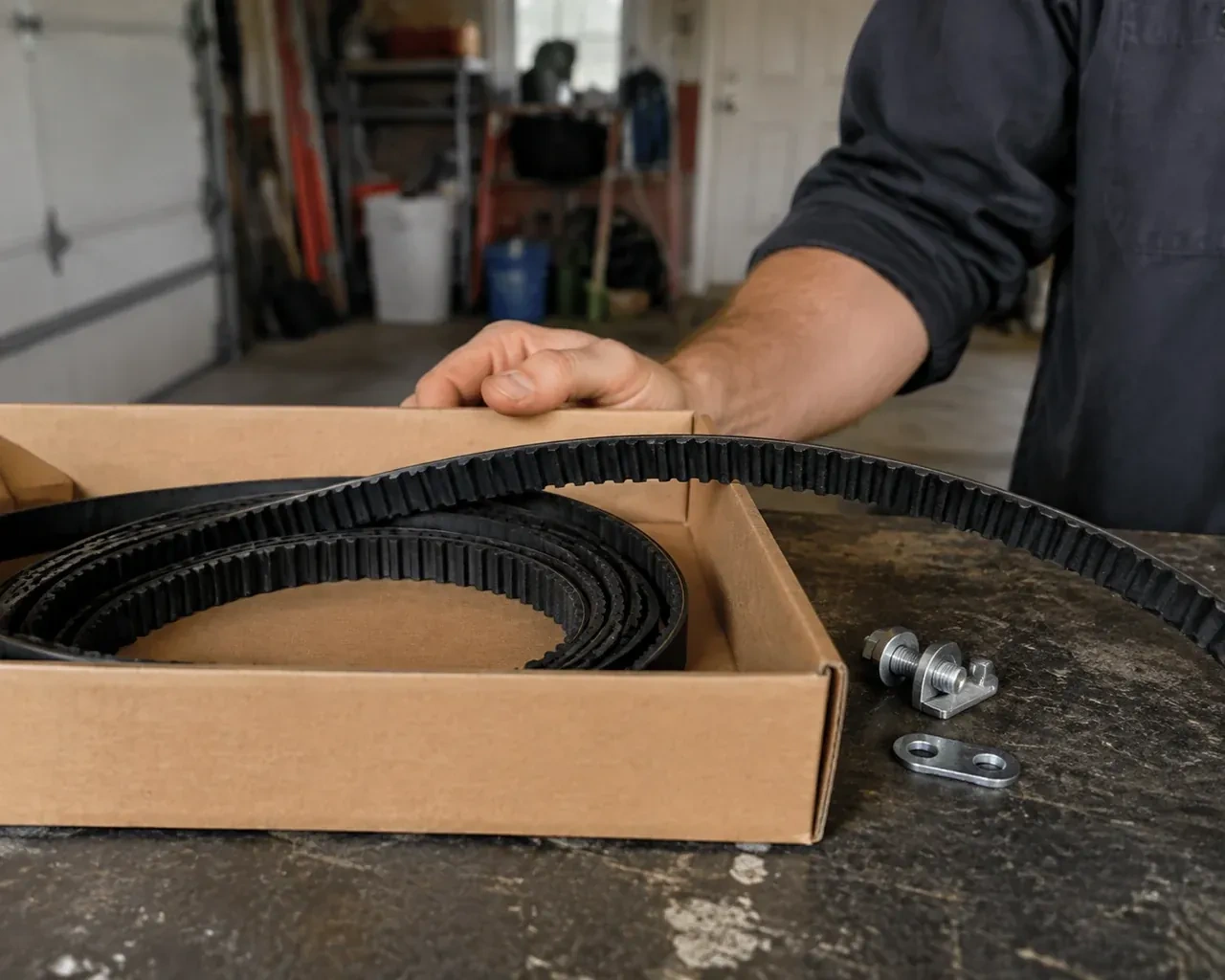
Halfway up, every single time, the door hesitates and there is a ratcheting sound from the motor head, then it carries on. A closer look shows a stretch of the belt where the teeth are worn almost flat.
Belt-drive opener repair fixes the part of a belt-driven operator that has failed. The drive train is simple: a reinforced rubber belt runs from a sprocket on the motor head, along the rail, around an idler pulley at the far end and back, pulling a trolley that is linked to the door by an arm. When the belt stretches, cracks, sheds teeth or loses its clip, or the trolley, sprocket or pulley wears, the door stalls, clatters or stops short. The technician tests the door's balance, finds the worn piece, replaces or adjusts it, brings the motor and trolley back into step and re-runs the safety tests.
Sound familiar?West Hamilton
Belt-Drive Opener Repair · West Hamilton
Scene 1
With the trolley run to one end of the rail and then the other, the whole length of the belt passes under the technician's eye and fingers, on the top run and the return. What they are looking for is specific: cracks across the back of the rubber, a glazed shine that says the belt has been slipping, an edge gone fuzzy from rubbing, a stretch where the teeth are flattened or torn away, cords showing through, and the state of the clip or link where the belt meets the trolley. Each of these points to a different cause as well as a different repair, and where the wear sits along the belt says a lot about which.
Scene 2
Any time the belt has been off the sprocket, the operator's sense of where the door is can drift from where the trolley actually sits, so this step is done before the door is reconnected. The technician lifts the belt clear of the sprocket, runs the operator until the sprocket turns to its closed position and stops on its own, then slides the trolley to the closed end of the rail and refits the belt. Motor and trolley now agree. On operators with a mechanical limit assembly, the middle contact is adjusted instead. Without this step, the door stops short at one end no matter how the travel limits are turned.
Scene 3
You now know where the release handle hangs and what happens when you use it. A pull parts the trolley so the door can be lifted by hand through a power cut; running the motor, or a second pull, reconnects it. What matters after this repair is to pull it only with the door closed. Releasing a door that is open, or one whose springs are tired, can let it fall because the spring no longer carries its weight; the release itself disconnects the trolley from the belt, so the falling door lands on its tracks and hinges, not the belt the technician just corrected. Practise it once with the door down so the first real use is calm.
What shapes the quoteMount Nemo Door Specialists
FeesSame any hour
Not usually. The trolley is checked while the belt is off: its halves should part with the release cord and lock again, the housing should be free of cracks and it should ride the rail without play. A trolley that passes those checks stays and simply receives the new belt and a fresh clip. One that sticks or rattles is replaced in the same visit.
Yes, every time. After the drive work and the relearning of travel and force, the technician runs the door onto a 2x4 laid flat on the floor to confirm it reverses on contact, and passes an object through the photo-eye beam while it closes to confirm it reverses again. The sensors' height and alignment are checked, and the tests are shown to you so you can repeat them monthly.
Yes. Belt, trolley and pulley work happens on the rail and leaves the operator's memory untouched. Replacing the gear at the motor head means opening the head unit, and on some models that is a good moment to confirm every remote, the keypad and any in-car buttons afterwards. The technician tests each before leaving and re-teaches any that need it.
HamiltonOntario
Belt-Drive Opener Repair · Hamilton, Buchanan, Central, Chedoke Park, Cootes Paradise, Corktown, Hamilton Beach, Hopkins Court, Hopkins Survey, McDonald Court, North End, University Gardens, Waterdown, Westdale, Pleasant View Survey
Every square is one home in a hundred.
On-site assessment
Halfway up, every single time, the door hesitates and there is a ratcheting sound from the motor head, then it carries on.
(289) 203-0726, open 24/7.
On-site assessment preferred · (289) 203-0726, open 24/7