Skip to content
MountNemo Door SpecialistsOpen 24/7 (289) 203-0726
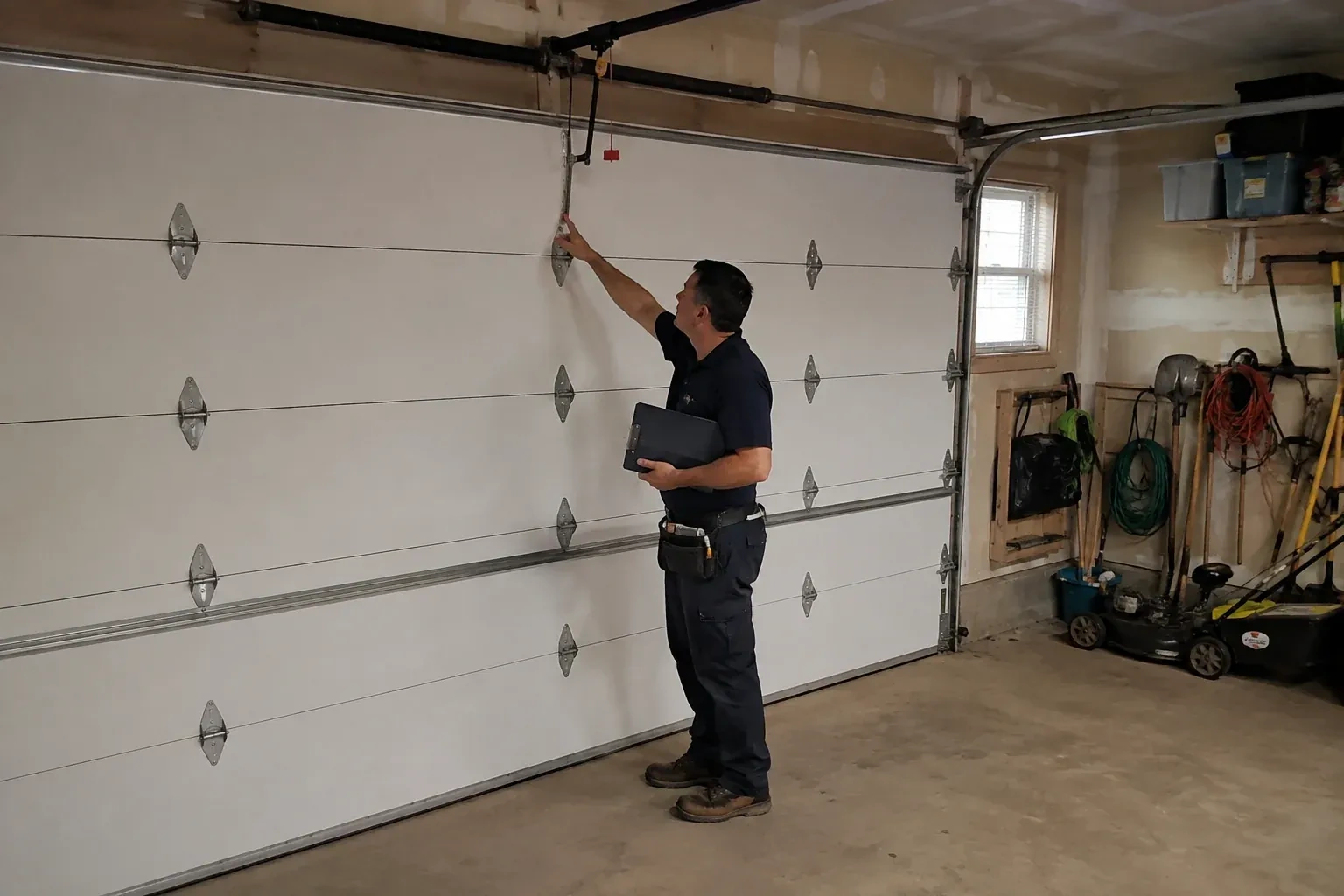
A person holding a clipboard examines the interior hardware of a closed garage door. — Garage Door Tune-Up, Central

Repairs · Central

Garage Door Tune-Up

Since the first cold snap the door has been sluggish. It climbs slowly, hesitates near the top and the opener motor sounds strained.

In plain words

The heart of a tune-up is the balance check. Your springs are meant to carry nearly the whole weight of the door so the opener only has to guide it. When the door is disconnected from the opener and lifted by hand, it should rise without effort, stay open on its own and hold still partway. A door that sinks or feels heavy is telling you the springs have lost tension, and an opener made to move a balanced door is straining. The tune-up identifies this and treats spring adjustment as its own carefully done job, with the door clamped and proper winding bars.

Sound familiar?Central

The call
Twice this week the door started closing, stopped a metre from the floor and reopened on its own. One of the little sensor lights near the floor blinks instead of glowing steady, and the wall button has to be held to close it.
NextHow the visit goes

Garage Door Tune-Up · Central

How the visit goes

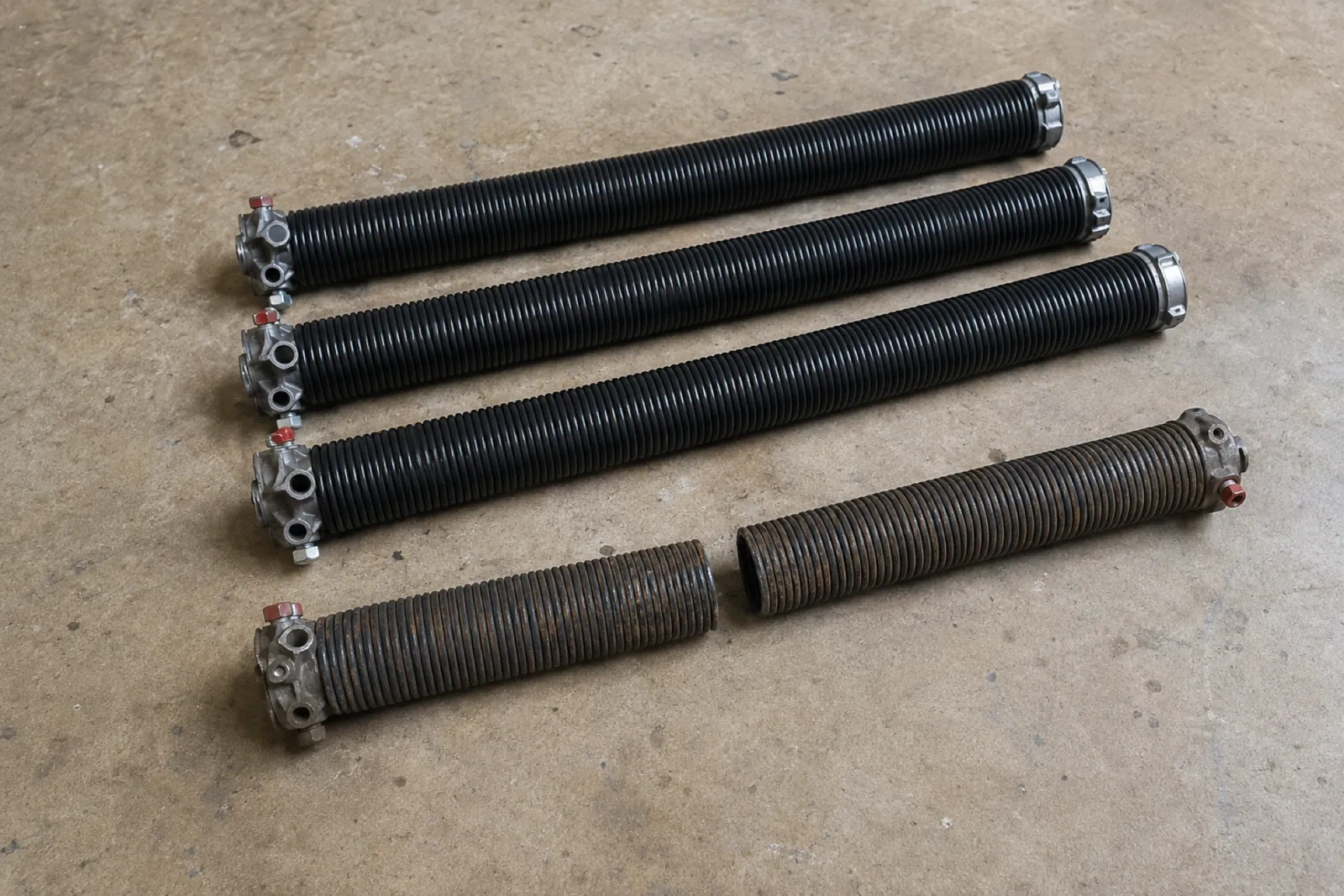
Four long coiled garage-door springs on a concrete floor, three black with metal end cones and one rusty spring broken in two. — Central
  1. Scene 1

    Hardware, bracket by bracket

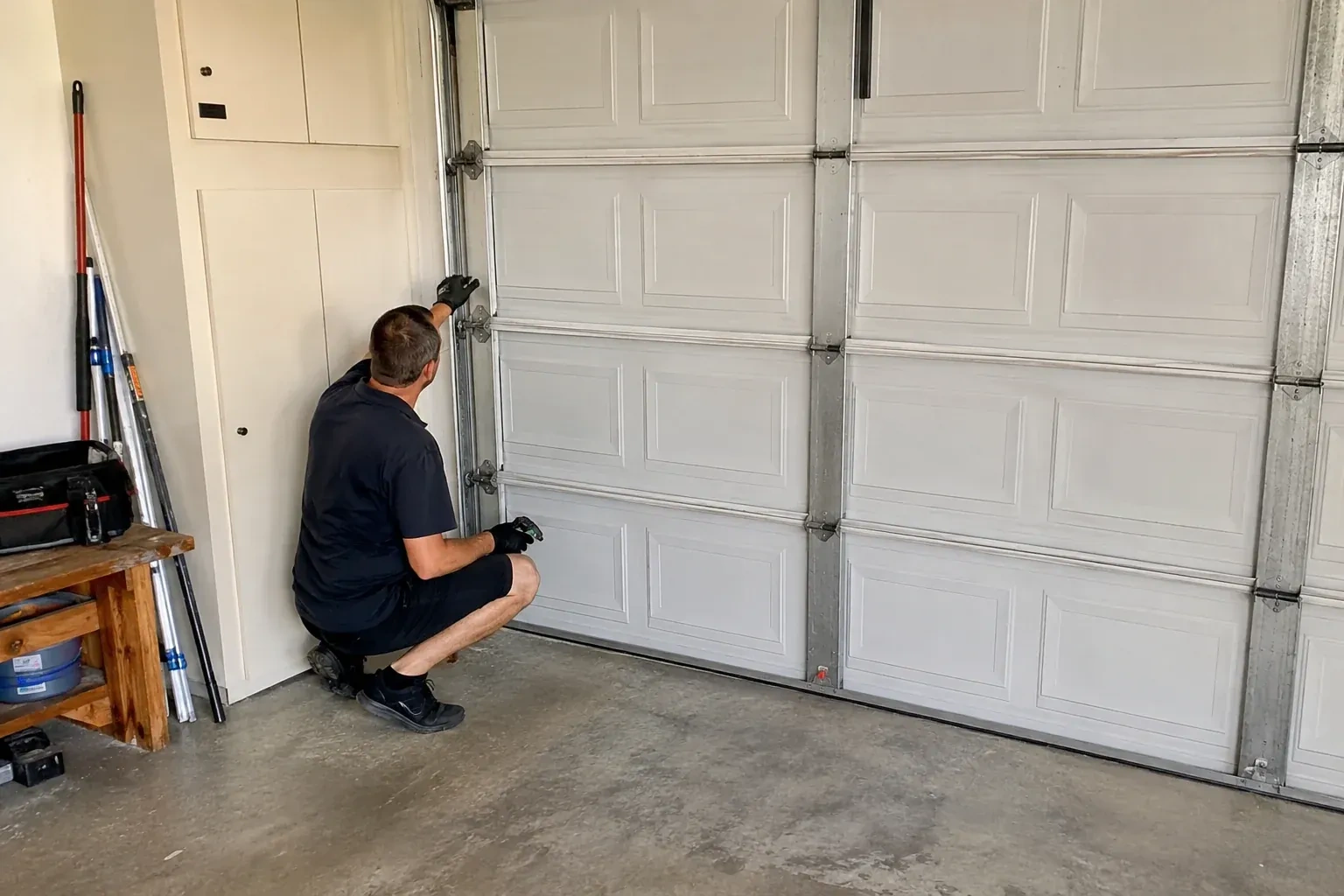
    With the door closed and still, the inspection moves along the panels from the bottom up. Bottom brackets and cable attachments are looked at for rust, cracks and cable fraying but not touched, because they hold spring tension. Hinges are checked for cracked knuckles and elongated screw holes. Rollers are spun and wiggled to feel for flat spots, loose stems and worn bearings. Track brackets and lag bolts are tested for movement. At the top, the springs, drums, bearing plates and centre bracket are examined, and the opener's header bracket and the door arm's connection to the top section are confirmed solid. Every loose or worn item is noted before anything is tightened.

  2. Scene 2

    Seals and the threshold

    Rubber and vinyl get a silicone spray, never a petroleum product, which attacks the material. A bottom seal that is torn or has flattened can be replaced in the same visit if stock is on hand: the old length is drawn out of the retainer, the retainer is cleaned, and the new astragal is fed in and trimmed to width. Jamb and header weatherstrip that has gone hard or split is renewed so the door closes against a flexible edge and stops rattling in wind. Where the threshold holds water, the technician points out the low spot and suggests keeping it clear of ice, since a seal frozen to the slab is the usual winter casualty.

  3. Scene 3

    When to book the next one

    How soon the door wants another visit depends on how hard it works. A door that cycles a few times a day, in an attached garage that sees salt, snow and meltwater every winter, does well with a tune-up once a year, usually in the fall before the cold arrives. A lightly used door in a detached garage can often go longer, with the monthly reversal tests and a little lubricant from you in between. The written record is your guide: if it lists parts to watch, the next visit checks those first; if everything was healthy, the interval can stretch. The technician will suggest a timing that fits your door rather than a blanket schedule.

In the van

  • Photo-eye brackets and wire
  • Bottom seal (astragal)
  • Locking pliers or C-clamps
  • Silicone or lithium garage door lubricant
  • Replacement steel or nylon rollers

What shapes the quoteMount Nemo Door Specialists

Condition of rollers and hinges
Worn rollers or a cracked hinge found during inspection can be replaced on the spot if you choose, and each replaced part is listed as its own line on the quote.
Torsion or extension springs
Torsion springs above the header and extension springs beside the tracks are inspected differently, and extension systems have pulleys and safety cables that add items to the checklist.
Written record and follow-up
A basic handover note is part of every visit. A detailed condition report with photographs for a landlord, a strata or a home sale is available as an added item.

FeesSame any hour

Have it ready

Before you call · 0 / 3

(289) 203-0726

Answers in plain language

Why does my door struggle in cold weather?

Cold affects several things at once. Old lubricant thickens into a drag on every hinge and bearing. Steel contracts slightly, so a track that was snug becomes tight. Rubber seals stiffen and the bottom seal can freeze to the slab. The opener then reads all this extra resistance as an obstruction and stops or reverses. A fall tune-up with a low-temperature lubricant, silicone on the seals and correctly set force goes a long way toward smooth winter mornings.

Do you adjust the springs during a tune-up?

Springs are inspected and lubricated during a tune-up, and the balance test tells us whether they are carrying the door's weight properly. Changing their tension is a separate, deliberate job: the door is clamped to the track, winding bars are used on a torsion spring, and the technician works from a stable position. If the balance check shows the springs need adjustment or replacement, you receive that as its own recommendation with its own quote.

The sensor light is blinking. What does that mean?

On most openers a steady light on each photo-eye means the pair are aligned and seeing each other, and a blinking light means the beam is interrupted or the sensors are out of line. Common causes are a bracket nudged by a bin or a tire, dust or salt film on a lens, low sun at a certain hour, or a chafed wire. During a tune-up the lenses are cleaned, the brackets straightened, the pair realigned and the wiring checked back to the opener.

Centralinformation

HamiltonOntario

Town
Central, Hamilton
In business
12 years
Hours
Open 24/7
Nights, weekends and holidays, same fees
Visits
On-site assessment preferred. Request a visit or call.

2021 census: what it means at the door

Every square is one home in a hundred.

  • 61 in 100 homes · older homes
  • About 61% of homes in Hamilton were built in 1980 or earlier, according to the 2021 Census.Older houses frequently have a garage door that was replaced once already, sometimes with a door chosen for the opening rather than the building. When that door reaches its end, there is a chance to pick a style that suits the house properly, and we measure with that in mind.
  • Single-detached houses make up about 56% of homes in Hamilton (2021 Census).Mixed housing often means mixed access too: individual remotes and keypads on the houses, building fobs and shared gates on the condos. We program, clear and replace all of these, and keep property managers in the loop where a door serves more than one household.

Source: Statistics Canada, Census Profile

Open Central in Google Maps

On-site assessment

Request a visit.

Since the first cold snap the door has been sluggish.

(289) 203-0726, open 24/7.