Skip to content
MountNemo Door SpecialistsOpen 24/7 (289) 203-0726
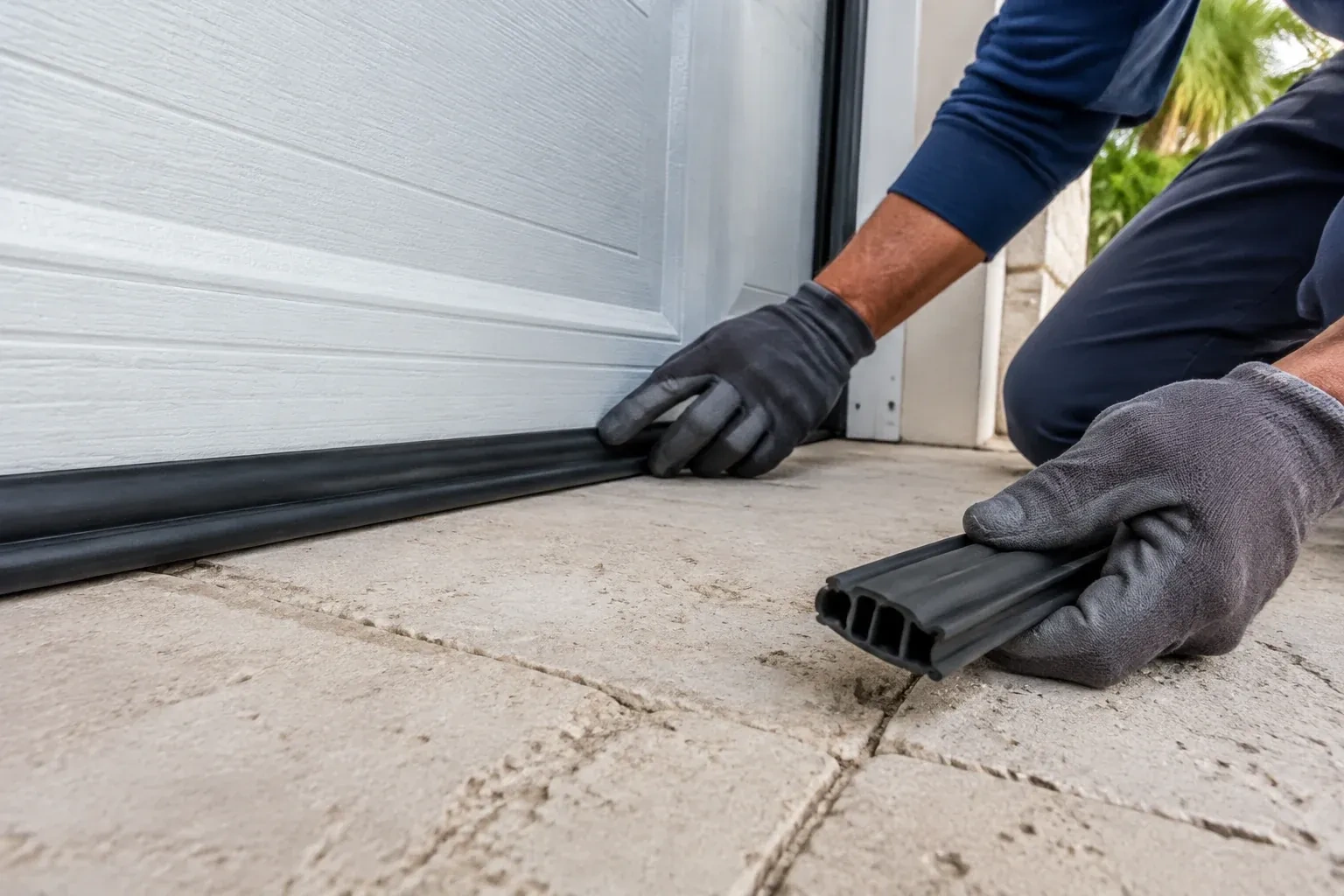
Gloved hands setting a black rubber seal along the base of a white garage door, holding a ribbed strip over paving stones. — Garage Door Bottom Seal Replacement, Hopkins Survey

Repairs · Hopkins Survey

Garage Door Bottom Seal Replacement

The garage doubles as a workshop, and with the heater running the floor near the door stays cold and the draft finds your ankles at the bench. When the wind is up you can feel the air moving under the door.

In plain words

Bottom seals come in a handful of profiles, and the retainer on your door decides which one fits. A T-style seal has T-shaped edges that slide into a single or double channel; a bead seal has rounded edges for the bead channels found on many older steel doors; a bulb or U-style seal is a larger tube that compresses further and suits rough or dished floors. The technician measures the channel spacing and the door width, then picks the profile, height and material to match. A correctly matched seal slides home, stays put through thousands of cycles and closes evenly along its whole length.

Sound familiar?Hopkins Survey

The call
The strip under the door has gone as hard as a hose left out for ten summers. Press it and it does not give; bend it and it cracks. Where the door meets the floor it sits on the concrete without squashing at all.
NextHow the visit goes

Garage Door Bottom Seal Replacement · Hopkins Survey

How the visit goes

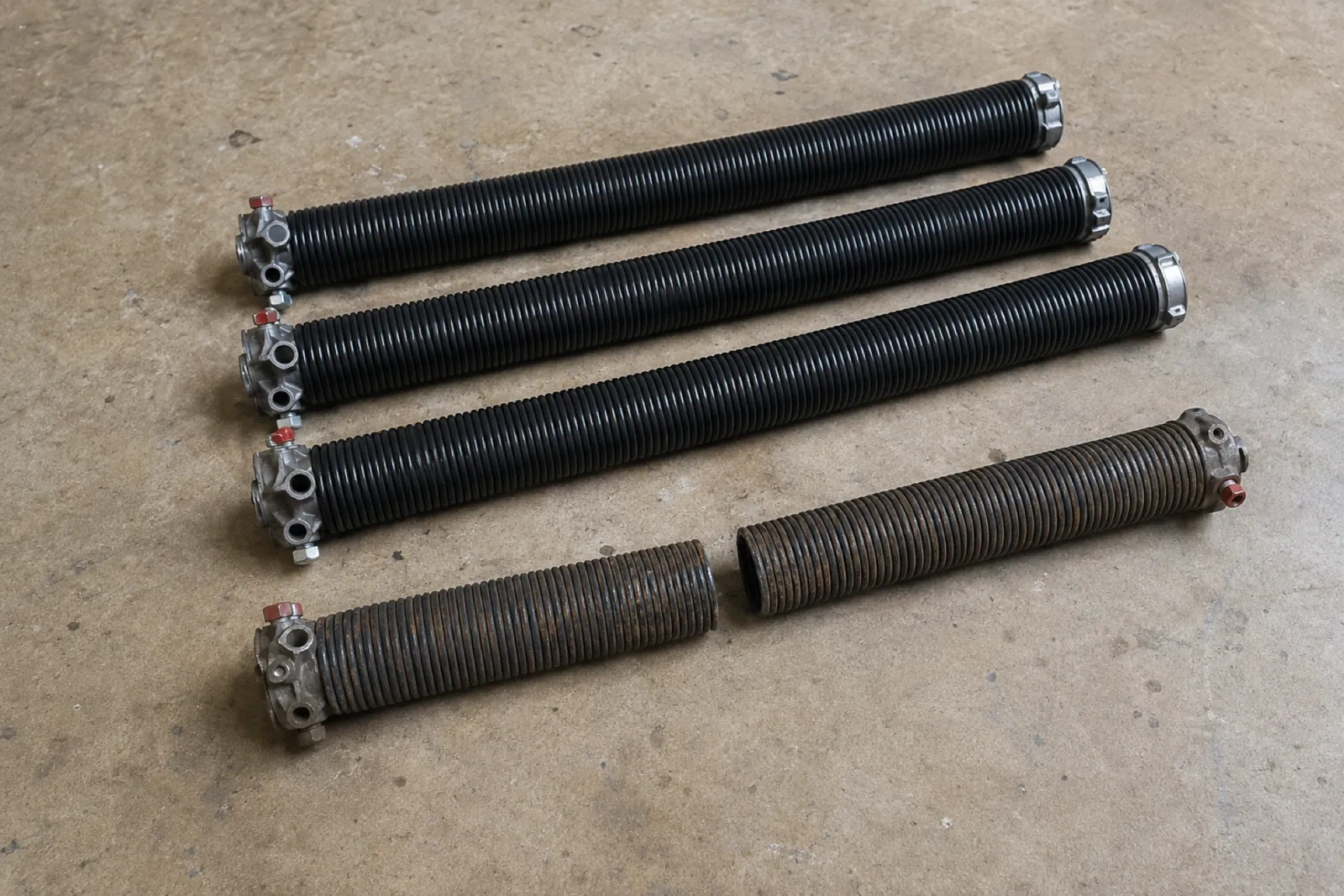
Four long coiled garage-door springs on a concrete floor, three black with metal end cones and one rusty spring broken in two. — Hopkins Survey
  1. Scene 1

    Which retainer and which profile

    Next the retainer along the bottom rail is identified. Most steel doors carry an aluminum extrusion with two channels that take the T-shaped or beaded edges of a U-shaped seal; some insulated doors have the channel moulded into a plastic bottom cap; older doors may have a single channel; wood doors often have a strip nailed straight to the rail. The technician measures the channel spacing and the T or bead size, checks the door width, and notes the height of the old strip. A seal chosen from these measurements slides in cleanly and holds, which is the difference between a replacement that lasts and one that works loose.

  2. Scene 2

    Fitting a new retainer where needed

    If the inspection found a retainer that is bent, corroded or spread open, it is replaced before the seal goes in. The old extrusion is unscrewed or its rivets drilled out, the bottom rail is cleaned and any rust treated, and a new aluminum retainer is fixed straight along the rail with fresh self-drilling screws, checked with a straightedge so the channels run true. Fastener heads are sealed against meltwater. On a door whose channel was moulded into a plastic bottom cap, a screw-on retainer is fitted over the rail so a standard seal can be used from now on.

  3. Scene 3

    The opener stays in step with the seal

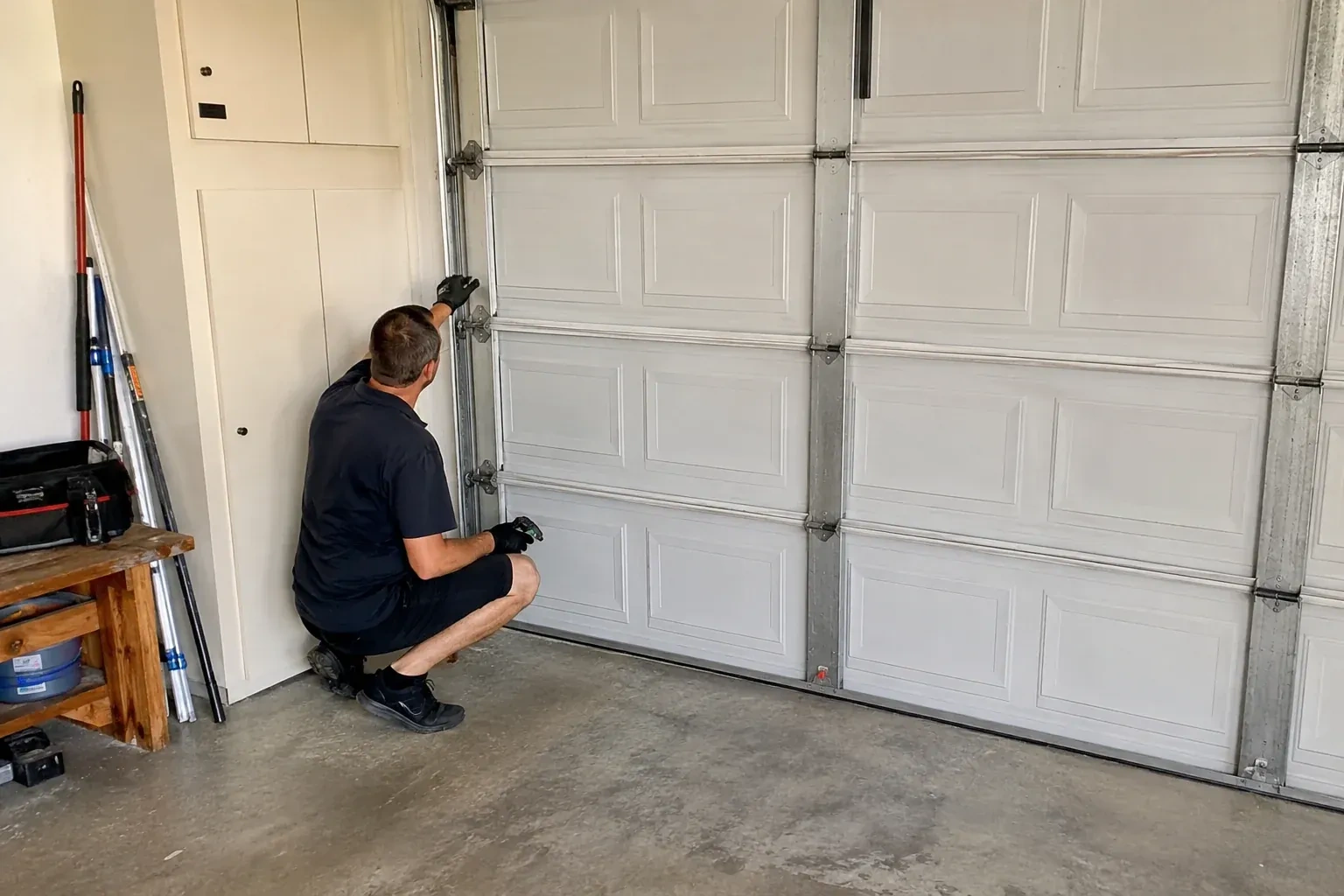
    The opener was reset to the new seal height, and it will hold that setting until something changes. If the door begins to reverse just before the floor, stops short and leaves a gap, or lands with a thump, the down limit or force has drifted or the seal has taken a set, and a small adjustment puts it right. The reversing test with a 38 mm (1.5 in) solid object, or a 2x4 laid flat under the door, is worth repeating monthly and after any adjustment, as the industry checklist for homeowners describes. A door that closes gently and reverses on an obstruction is one whose seal and opener are working together.

In the van

  • Wire brush and scraper
  • Threshold seal and adhesive
  • Nail-on vinyl strip for wood doors
  • Seal end caps
  • Silicone spray lubricant

What shapes the quoteMount Nemo Door Specialists

Opener adjustment
Resetting the down limit and force and repeating the reversing test after a taller seal is fitted is a short step that the quote names whenever the door has an opener.
Wood door nail-on strip
A wood door with a nailed strip takes a different product and more fastening time than a channel seal, and adding a retainer to a wood rail is a further option to consider.
Bottom section repairs
A rusted, dented or bowed steel bottom rail, or a rotted wood rail, is pointed out and any repair or reinforcement offered as an option beside the seal work.

FeesSame any hour

Have it ready

Before you call · 0 / 3

(289) 203-0726

Answers in plain language

Why is the gap much bigger at one corner?

Two causes are common. The door may be hanging out of level because a lift cable has stretched, a drum has crept on its shaft or spring tension is uneven, which drops one corner. Or the slab may have settled or heaved at that end so the floor falls away. The technician checks both before choosing a seal, since a level door and the right seal height together close a wedge-shaped gap.

What is a threshold seal, and when is it worth adding?

A threshold seal is a rubber or aluminum-backed strip glued to the garage floor along the line where the door closes. The door's bottom seal lands on it, and its raised outer edge turns water, wind-blown debris and small visitors back toward the driveway. It earns its place where the drive slopes toward the garage, the slab sits below the apron, or the floor edge is too uneven for the bottom seal alone to meet cleanly.

How do I know which size and type my door takes?

Look at the end of the bottom section for the metal or plastic strip that holds the seal. Count the channels, note whether they are slotted or rounded, and measure the distance between them and the width of the door. A photo of the end of the retainer and one of the seal's cross-section is usually enough for the technician to identify the profile before the visit and bring the right roll.

Hopkins Surveyinformation

HamiltonOntario

Town
Hopkins Survey, Hamilton
In business
12 years
Hours
Open 24/7
Nights, weekends and holidays, same fees
Visits
On-site assessment preferred. Request a visit or call.

2021 census: what it means at the door

Every square is one home in a hundred.

  • 61 in 100 homes · older homes
  • About 61% of homes in Hamilton were built in 1980 or earlier, according to the 2021 Census.Where most houses were built a generation or more ago, a good share of garage doors are still the originals: wood or early steel sections on extension springs. Those doors respond well to fresh pulleys, safety cables and a careful balance, and the technician carries the parts for them.
  • Single-detached houses make up about 56% of homes in Hamilton (2021 Census).Where housing is varied, security needs vary too. A detached home wants its garage door closing fully and its interior door respected; a townhouse or condo wants old fobs and remotes cleared and the shared entrance working. We address whichever applies at each door.

Source: Statistics Canada, Census Profile

Open Hopkins Survey in Google Maps

On-site assessment

Request a visit.

The garage doubles as a workshop, and with the heater running the floor near the door stays cold and the draft finds your ankles at the bench.

(289) 203-0726, open 24/7.